
- They share the same origin, but today they are three different breeds.
- The Staffy is the smallest (up to 17 kg); the Amstaff reaches 32 kg; the Pit Bull is not recognised by the FCI.
- A “Pit Bull” with an ENCI pedigree does not exist, and none of the three breeds is banned in Italy.
On this page
Staffordshire Bull Terrier, American Staffordshire Terrier and American Pit Bull Terrier descend from the same stock, the Bull and Terriers of 19th-century England, but today they are three distinct breeds. The Staffordshire Bull Terrier is the smallest, with a maximum weight of 17 kg, and is recognised by the FCI under standard no. 76. The American Staffordshire Terrier is taller and heavier, up to 32 kg in males, and is recognised by the FCI under standard no. 286. The American Pit Bull Terrier, whose weight varies widely between 15 and 27 kg, is registered by the American UKC and ADBA but not by the FCI, so in Italy the ENCI cannot issue it a pedigree: a Pit Bull with an ENCI pedigree does not exist. None of the three is banned in Italy. A guide by Del Piccolo Diavolo, a Staffy breeder in Ostellato (Ferrara, Italy) since 2013.
Why are these breeds confused?
The confusion between Staffordshire Bull Terrier, American Pit Bull Terrier and American Staffordshire Terrier is extremely common, not only among laypeople but also in the media and sometimes in institutions. This confusion has concrete consequences: poorly written laws, unjustified prejudice and difficulties for owners.
All three breeds descend from the same stock: the "Bull and Terrier" dogs of 19th-century England, crosses between Bulldogs and various Terriers. They therefore share a common genetic heritage and some similar physical traits: a broad head, a powerful jaw, a muscular body.
The media tend to use the generic term "Pitbull" for any "bull" type dog, whatever its actual breed. When a molosser-type dog is involved in an incident, the breed is rarely identified correctly, which feeds generalised stereotypes.
Everyday language does not help either: in Italy "Pitbull" is often used as an umbrella term for any muscular dog with a broad head, when in fact the American Pit Bull Terrier is one specific breed (and one the FCI does not recognise).
Historical origins: a common ancestor
To understand the differences between these breeds, it helps to go briefly through their shared history and the point where they diverged.
19th-Century England: the Bull and Terriers
In 19th-century England, animal fights were popular. The Bull and Terriers were born from crosses between Bulldogs (strength, grip) and Terriers (agility, tenacity). These dogs were used for bull-baiting and later, after the ban of 1835, for dog fighting.
From this common stock came several lines that would give rise to the modern breeds.
The Staffordshire Bull Terrier: the British breed
The Staffordshire Bull Terrier developed in the Staffordshire region of England. In 1935 it was officially recognised by the British Kennel Club. The standard was written to preserve the traits of the traditional dogs of the English working class, with an emphasis on a balanced temperament and suitability for family life.
The FCI (Fédération Cynologique Internationale) recognises the Staffordshire Bull Terrier under standard no. 76, in Group 3 (Terriers), Section 3 (Bull type Terriers).
The American breeds: Pit Bull and Amstaff
In the 19th century many Bull and Terriers were taken to America by British immigrants. In the United States these dogs developed in two distinct directions:
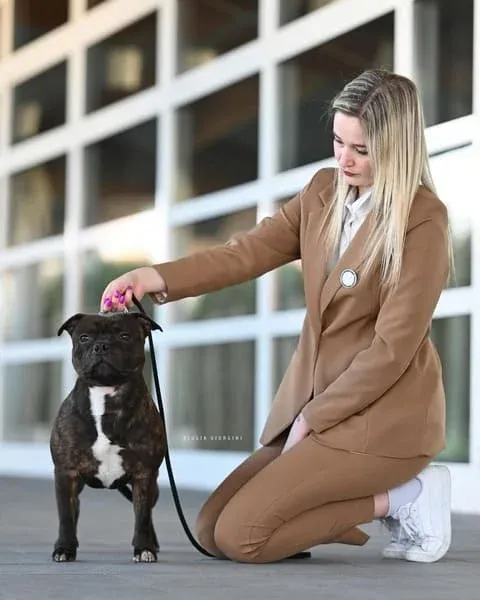
American Pit Bull Terrier (APBT): recognised by the UKC (United Kennel Club) in 1898 and by the ADBA (American Dog Breeders Association). The UKC was founded precisely to register this breed. The APBT is not recognised by the FCI nor by the AKC (American Kennel Club).
American Staffordshire Terrier: in 1936 the AKC recognised a "show" version of the American Pit Bulls under the name "Staffordshire Terrier", renamed "American Staffordshire Terrier" in 1972 to set it apart from the British Staffy. The FCI recognises it under standard no. 286.
📜 A Historical Note
In the early years many dogs were registered at the same time as APBTs with the UKC and as American Staffordshire Terriers with the AKC. The two breeds therefore share an almost identical genetic heritage; the difference is that the Amstaff was selected for the show ring and the APBT for "performance".
Physical comparison: the table of differences
Here are the concrete physical differences between the three breeds. The table below sums up the main traits. The Amstaff's FCI standard sets no weight: the figure in the table is the usual weight.
| Trait | Staffordshire Bull Terrier | American Pit Bull Terrier | American Staffordshire Terrier |
|---|---|---|---|
| Height, males | 35.5 - 40.5 cm | 45 - 53 cm | 45.7 - 48.2 cm |
| Height, females | 35.5 - 40.5 cm | 43 - 50 cm | 43 - 46 cm |
| Weight, males | 12.7 - 17 kg | 15 - 27 kg | 25 - 32 kg |
| Weight, females | 11 - 15.4 kg | 13 - 23 kg | 18 - 25 kg |
| Head | Short, broad, deep skull | Medium length, flat skull | Medium length, very broad |
| Muzzle | Short | Medium, square | Medium, rounded on top |
| Ears | Rose or half-pricked | High set, cropped or natural | High set, cropped or natural |
| Body | Compact, muscular, close-coupled | Athletic, agile, muscular | Sturdy, muscular, "stocky" |
| FCI recognition | ✅ Standard no. 76 | ❌ Not recognised | ✅ Standard no. 286 |
| ENCI recognition | ✅ Yes | ❌ No | ✅ Yes |
| Country of origin | Great Britain | United States | United States |
How to tell them apart at a glance
The Staffordshire Bull Terrier is the smallest and most compact. Its head is broad and short in relation to the body, with very pronounced cheeks. The body is close-coupled, muscular but not exaggerated. Maximum weight 17 kg. It is the only one whose ears are never cropped.
The American Pit Bull Terrier is medium-sized, taller and leaner than the Staffy. Its body is athletic, built for agility more than mass. Its weight varies widely (15-27 kg).
The American Staffordshire Terrier is the largest and most massive. It has a very broad head and a sturdy, muscular body. Males weigh up to 32 kg.
Differences in character and temperament
Staffordshire Bull Terrier
The FCI standard describes the Staffy's temperament as traditionally of indomitable courage and tenacity, highly intelligent and affectionate, especially with children. The Staffy is known for its strong attachment to its human family, so much so that it has been nicknamed the "nanny dog".
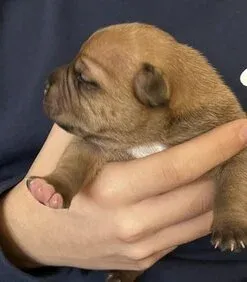
American Pit Bull Terrier
The APBT was historically selected for "gameness" (tenacity, determination) and athleticism. The UKC standard describes it as strong, confident and full of zest for life. It excels in dog sports such as weight pulling, agility and obedience.
American Staffordshire Terrier
The Amstaff, selected for the show ring, tends to have a slightly calmer temperament than the APBT.
🐕 A note on temperament
An individual dog's temperament depends far more on its specific genetics (bloodlines), socialisation and upbringing than on the breed itself. The choice of breeder and the owner's commitment are decisive factors.
Legal status and recognition
In Italy
Staffordshire Bull Terrier: recognised by the ENCI. Puppies born to registered parents have an ENCI pedigree (LOI, the Italian stud book). No specific restrictions.
American Staffordshire Terrier: recognised by the ENCI. Same situation as the Staffy.
American Pit Bull Terrier: not recognised by the ENCI or the FCI. No official pedigree exists in Italy.
⚠️ Beware of "Pit Bulls" Without a Pedigree
In Italy a dog sold as a "Pit Bull" cannot have an ENCI pedigree, because the breed is not recognised. Many dogs sold as "Pit Bulls" are in fact crosses of various kinds. If you are looking for a bull-type dog with guarantees, look at Staffy puppies or Amstaffs from ENCI breeders.
Which breed to choose?
This page is for telling the three breeds apart and understanding what the law says. If you have already ruled out the Pit Bull and need to choose between a Staffy and an Amstaff, the dedicated guide lines up the practical questions about space, experience and daily life: which of the two breeds suits you.
The Del Piccolo Diavolo kennel breeds only the Staffordshire Bull Terrier: a breed with a clear FCI standard, genetic tests for L2-HGA and HC, and a size suited to life in the house.