
- In Italy the Staffy is not a dangerous breed: the list was abolished in 2009.
- The rules for every dog apply: lead, muzzle when needed, owner responsibility.
- There are still local rules (towns, apartment buildings) and those of other countries, to check before travelling.
On this page
- The myth of the dangerous breed
- What the data say: the Royal Veterinary College study
- The legal position in Italy
- How Italy got here: from the 2006 list to the 2009 ordinance
- The Lombardy proposal and the "save list"
- Across Europe, country by country
- The situation elsewhere in Europe
- What the breed's temperament actually is
- The "nanny dog" myth: what it means and what it does not
- Insurance, housing and everyday practicalities
- What responsible ownership looks like in practice
- Frequently asked questions
In Italy the Staffordshire Bull Terrier is not on any list of dangerous breeds: the list was abolished by the Ministry of Health ordinance of 2009, which moved responsibility from the breed to the owner. No breed is banned or subject to special obligations nationwide, and the rules apply to every dog: a lead no longer than one and a half metres in public places, a muzzle carried and fitted when required, microchip, registration and full civil liability of the owner. Local rules on parks or beaches, rental contracts and some airlines can be stricter, and other European countries differ. A 2020 Royal Veterinary College study of 1,304 Staffordshire Bull Terriers and 21,029 other dogs found no significant difference in the odds of aggression. The breed's reputation is made by its owners, one dog at a time. A guide by Del Piccolo Diavolo, a Staffordshire Bull Terrier breeder in Ostellato (Ferrara, Italy) since 2013.
The myth of the dangerous breed
The idea that certain breeds are inherently dangerous has shaped legislation across Europe for 30 years, and the evidence for it has never been strong. Breed-specific legislation rests on the assumption that aggression is a fixed property of a breed rather than the outcome of genetics, upbringing, training, management and the specific situation in which a bite occurs.
Where such laws have been introduced and then studied, the results have been consistently disappointing. Bite statistics have not fallen in proportion, partly because breed identification by witnesses is unreliable, partly because the dogs involved in serious incidents are usually those kept in poor conditions by owners who ignore the law in any case. The Staffy, moreover, is often confused with the American Pit Bull Terrier and with the American Staffordshire Terrier: when a bull-type dog is involved in an incident, it gets called a "Pit Bull" or a "Staffy" whatever its breed. Several countries that pioneered breed lists have since repealed or narrowed them for exactly this reason.
What the data say: the Royal Veterinary College study
In 2020 the Royal Veterinary College in London published the first large study to test the breed's reputation against clinical records. Working within the VetCompass™ programme, the researchers reviewed the 2016 records of dogs under primary veterinary care in the United Kingdom: 1,304 Staffordshire Bull Terriers and 21,029 dogs of other breeds.
The study started from the hypothesis that Staffordshire Bull Terriers would show higher odds of aggression. The data did not support it: there was no statistically significant difference between the breed and other dogs (odds ratio 1.09, 95% confidence interval 0.75 to 1.58, p = 0.644). An interval that runs from below 1 to above 1 means the study found no measurable difference in either direction.
The same study found higher odds for four of the 36 most common conditions examined, seizures among them, and lower odds for five. That is a health profile of the breed, not a verdict on its temperament. Source: Pegram et al., Canine Medicine and Genetics, 2020.
The legal position in Italy
Italy is, on this point, one of the more rational jurisdictions in Europe. The list of allegedly dangerous breeds was abolished by the ministerial ordinance of 2009, and the principle that replaced it has been confirmed by every subsequent ordinance: responsibility lies with the owner, not with the breed.
In practice this means there is no breed restriction on owning a Staffordshire Bull Terrier in Italy, no muzzle requirement based on breed, and no compulsory insurance based on breed. The obligations that do exist apply to every dog and every owner: a lead no longer than one and a half metres in public places, a muzzle carried and available to be fitted on request of the authorities or when the situation requires it, microchipping and registration, and full civil liability for any damage the dog causes.
Individual municipalities can impose stricter local rules on specific areas such as parks or beaches, and a judge can order a behavioural assessment and mandatory training for a specific dog after an incident. Both of these are dog-specific, not breed-specific.
How Italy got here: from the 2006 list to the 2009 ordinance
In December 2006 the then Minister of Health, Livia Turco, issued an ordinance on protecting public safety from dog attacks, with an annex listing 17 breeds considered at risk, among them the Pit Bull, the Rottweiler, the Dogo Argentino, the Fila Brasileiro and the Tosa Inu. The Staffordshire Bull Terrier was not on that list; it ended up associated with it only in everyday language, through its resemblance to the Pit Bull.
The list lasted barely two years. The ordinance signed on 3 March 2009 by the undersecretary Francesca Martini abolished it, stating that veterinary science does not allow the risk of greater aggressiveness to be established on the basis of a dog's breed or crosses. What that ordinance introduced still applies: a lead of at most one and a half metres in urban areas, a muzzle carried and fitted on request, a register of dogs that have bitten kept by the local health authorities, and the civil and criminal liability of the owner. Source: the Italian Ministry of Health, ordinance of 3 March 2009.
The Lombardy proposal and the "save list"
In January 2025 the Lombardy Region presented a bill with a "save list" of 26 types of dog, whose owners would have to complete a theory course of at least ten hours and a practical course of at least six, ending with the CAE-1 test run by the ENCI, the Italian Kennel Club. The first version of the list included the Staffordshire Bull Terrier. On 24 June 2025 the regional council approved the text as a bill to be sent to the national Parliament: it is not a regional law, and it has no effect until Parliament passes it.
The approved text contains two changes that matter to anyone choosing a Staffy. First: the Staffordshire Bull Terrier is no longer on the list. Second: it excludes dogs registered in the stud books, that is, dogs with an ENCI pedigree, and prohibits breeding and rehoming non-pedigree dogs of the listed types, to stop backyard litters. Source: the consolidated text published by Anmvi Oggi.
The list in the approved text, crosses included:
| The 26 types in Annex A, text approved on 24 June 2025 | ||
|---|---|---|
| Dogo Argentino | Fila Brasileiro | Japanese Tosa |
| American Pit Bull Terrier | Bull Terrier | American Staffordshire Terrier |
| Bullmastiff | Rottweiler | Cane Corso |
| American Bulldog | Sarplaninac | Anatolian Shepherd |
| Central Asian Shepherd | Caucasian Shepherd | Maremma Sheepdog |
| Belgian Malinois | German Shepherd | Rafeiro do Alentejo |
| Rhodesian Ridgeback | Tosa Inu | Bandog |
| Boerboel | Akita Inu | American Akita |
| Czechoslovakian Wolfdog | Saarloos Wolfdog | |
Across Europe, country by country
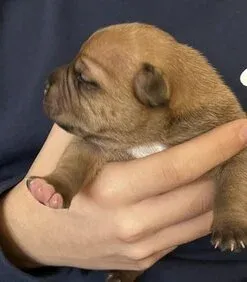
In the United Kingdom the Dangerous Dogs Act 1991 prohibits four types: the Pit Bull Terrier, the Japanese Tosa, the Dogo Argentino and the Fila Brasileiro. The Staffordshire Bull Terrier is not among them and is one of the most popular breeds in the country. In Germany a federal law of 2001 forbids bringing four breeds and their crosses into the country to keep them there: the Pit Bull Terrier, the American Staffordshire Terrier, the Bull Terrier and the Staffordshire Bull Terrier too. On top of that the individual states keep their own lists, with requirements for people who already own such a dog. In France dogs are classified in two categories, and a Staffordshire Bull Terrier with a French LOF pedigree falls into neither. In Ireland the breed is on the list of dogs that must be muzzled and kept on a short lead in public by a person over sixteen.
The situation elsewhere in Europe
If you are reading this from outside Italy, the picture varies considerably and it matters if you intend to travel or relocate with your dog. In Germany the breed cannot be brought in to live there, and some federal states include it in their category lists, with requirements ranging from a temperament test to keeper permits. Denmark prohibits thirteen breeds, including the American Staffordshire Terrier and the Pit Bull Terrier, but not the Staffordshire Bull Terrier; a dog that resembles a prohibited type may still have to prove its breed, which is one more reason to travel with the pedigree. Ireland requires muzzle and short lead in public for a list of types. The United Kingdom, the breed's country of origin, does not restrict it at all.
Anyone planning to move a Staffordshire Bull Terrier across borders should check the destination's current rules directly rather than rely on second-hand information, because these lists change. We do this as a matter of course for every puppy that goes abroad, and we say so plainly to families when the destination has restrictions.
What the breed's temperament actually is
The Staffordshire Bull Terrier was selected for a specific and demanding combination: courage and tenacity towards other animals, and absolute reliability with people. Dogs that showed aggression towards humans were historically removed from breeding without discussion, because they were handled constantly and at close quarters.
The result is a breed whose defining characteristic is affection for people, including strangers and, famously, children. The breed standard of the Kennel Club describes it as bold, fearless and totally reliable, and it is one of very few standards to use the word reliable at all. This is why the breed carries the informal name of nanny dog, a nickname we treat with care: no dog of any breed should ever be left unsupervised with a small child, and affection is not a substitute for supervision.
The honest counterpart is that tolerance towards other dogs is not guaranteed. A Staffordshire Bull Terrier that has not been well socialised, or that has been encouraged to react, can be difficult with dogs of the same sex after maturity. This is a management question and it is entirely foreseeable, which is precisely why it should be discussed before a puppy is chosen rather than after.
The "nanny dog" myth: what it means and what it does not
You have probably heard the Staffordshire Bull Terrier called a "nanny dog". The nickname comes from the breed's reputation for patience with children, which is written into the standard too: "affectionate, especially with children". It does not mean the breed was designed to look after children: it describes tolerance and attachment to the human family, which is what makes the breed well suited to family life.

⚠️ Supervision is always necessary
Whatever the breed, no dog should ever be left alone with young children without an adult present. This applies to the Staffy exactly as it does to the Labrador, the Golden Retriever or any other breed.
Insurance, housing and everyday practicalities
Civil liability insurance is not compulsory in Italy for this breed, but we recommend it to every owner regardless of breed: policies are inexpensive and cover situations that have nothing to do with aggression, such as a dog causing a cyclist to fall.
Condominium regulations in Italy cannot prohibit the keeping of pets in privately owned flats, following the 2012 reform of condominium law. Rental contracts are a different matter and can contain clauses about animals, so the time to raise the question is before signing rather than after the puppy arrives. Some airlines and ferry operators apply their own breed restrictions that are stricter than national law, and these must be checked in advance for every journey.
What responsible ownership looks like in practice
Early and continuing socialisation, ideally beginning with the breeder and continuing through the first year. Basic obedience with a reliable recall, which is worth more than any muzzle. Never encouraging rough play that rewards mouthing or tugging against a person. Careful management around unfamiliar dogs rather than optimistic hoping. And enough physical and mental exercise that a strong, intelligent dog is not left to invent its own occupations.
None of this is exotic, and all of it is the ordinary work of owning a well-built terrier. The breed's reputation is made and unmade by owners, one dog at a time, and the single most useful thing a Staffordshire Bull Terrier owner can do for the breed is to have a visibly well-mannered dog in public.
That is why selection at the Del Piccolo Diavolo kennel starts from temperament: the males and females are tested, or clear by parentage with their parents' reports, and chosen for their balance as well, and the bloodlines are studied for temperament too. The Staffy puppies grow up in the house and then the yard, meeting people, noises and adult dogs in the weeks when it matters. More answers are in the FAQ and in the families' reviews; to arrange a visit, see the contact page.