
On this page
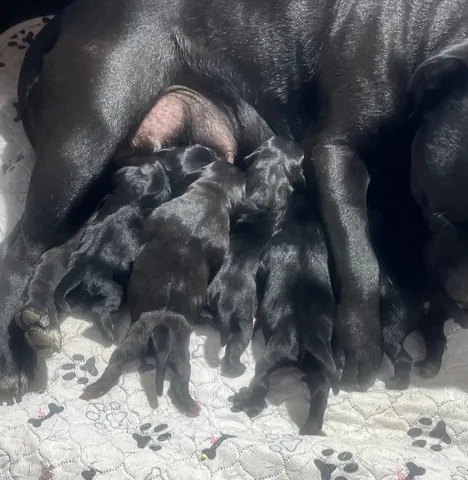
FCI standard no. 76 for the Staffordshire Bull Terrier allows five colours, red, fawn, white, black and blue, each with or without white, plus any shade of brindle, also with or without white. Black and tan and liver are colours that are not wanted: the standard calls them highly undesirable and they are penalised in the show ring, although as a companion such a dog is worth no less than any other. Brindle ranges from light to black brindle, so dark it looks almost black; black may be solid or with white markings on the chest, toes and muzzle. Blue is allowed just like black, but many breeders do not breed it: it is a dilute colour and can cause coat and skin problems. At the Del Piccolo Diavolo kennel in Ostellato, near Ferrara, Italy, the August 2026 litter from Bilquis and Black Jack produced black puppies and black brindle puppies with white.
What the official standard says
FCI standard no. 76 for the Staffordshire Bull Terrier lists the permitted colours precisely. Allowed are:
- Red
- Fawn
- White
- Black
- Blue
- Each of these with or without white
- Any shade of brindle, with or without white
The standard also names two colours as highly undesirable: black and tan (black with brown markings) and the liver colour. They are not colours to aim for: in the show ring such a dog is penalised, and a kennel that follows the standard does not use it for breeding. As a companion, though, it is worth as much as any other.
Black
Black is a smooth, glossy, even coat that highlights the Staffy's musculature. It can appear as solid black or black with white (markings on the chest, toes, muzzle).
It is a colour that conforms to the standard. The colours of each of our litters are listed on the Staffordshire Bull Terrier puppies page.
Brindle
Brindle is a fawn or reddish base crossed by dark striping, in endless shades. The standard allows any shade of brindle, from light to very dark (so-called "black brindle", so heavy it looks almost black).
It can be solid brindle or brindle and white (with markings). It is a colour tied to the history of the breed.
Fawn and red
Fawn covers the shades from cream/honey to golden beige, while red ranges from copper to an intense brick tone. Both are allowed with or without white. These dogs often have a darker facial mask.
White and pied
White is allowed, as are all colour + white combinations. Predominantly white dogs with coloured patches are often called pied. They conform to the standard.
The blue case: beauty and caution
Blue is a slate-grey that comes from a dilution gene acting on black. The standard allows it just like black, red or brindle. Many breeders, however, do not breed it, because the dilute colour can cause coat and skin problems.
A dog is born blue when it inherits a variant of the MLPH gene from both parents. As the laboratory Laboklin explains, this variant changes the way pigment reaches the hair: the pigment clumps and the hair becomes brittle. In some dilute dogs this leads to colour dilution alopecia (CDA): the coat thins, usually on the back and flanks, and the skin can become inflamed. In the Staffy, a case was described in 2021 of a blue bitch who began to lose her coat at six months.
Not every blue dog becomes ill. The genetic test tells you whether a dog is dilute, but not whether it will develop the condition: only a skin biopsy confirms it.
For this reason those who breed blue do so with caution and avoid matings between two diluted dogs (blue × blue), considered problematic from a health point of view. Be wary of anyone who promotes blue as a "rare and precious colour" at a high price while ignoring the health aspects: health comes before aesthetics.
How we choose
At our Del Piccolo Diavolo kennel the choice of breeding dogs always starts from health and breed type, not from the "fashion" of a colour. We select colours that conform to the standard, with parents tested for L2-HGA and HC, and we avoid risky diluted matings. A "rare" colour obtained at the expense of health is worth nothing.
Does colour affect temperament?
No: this is a myth to dispel. The coat colour has no relationship with the temperament of the Staffordshire Bull Terrier. A black, brindle or fawn dog can be equally sweet and balanced. Temperament depends on the parents' genetics, on socialisation and on how the puppy is raised, not on the shade of the coat.