
- The Staffy has three inherited diseases with a DNA test: L2-HGA, hereditary cataract (HC) and degenerative myelopathy (DM).
- They are recessive: two clear parents cannot have affected puppies.
- A certificate only counts if it shows the dog’s microchip number.
On this page
- Why genetic testing is not optional
- L2-HGA: what it is and how it presents
- Hereditary cataract (HC, HSF4 gene): what it is and how it presents
- Degenerative myelopathy (DM, SOD1 gene): what it is and how it presents
- How the tests work
- Reading the results
- Testing by parentage
- What to ask the breeder, and what should worry you
- Beyond the two DNA tests
- The cost of prevention against the cost of the disease
- Frequently asked
The Staffordshire Bull Terrier is a fundamentally healthy breed with two serious hereditary conditions that DNA testing can prevent entirely. L2-HGA, L-2-hydroxyglutaric aciduria, is a metabolic disease of the nervous system that usually appears between six months and one year. Hereditary cataract, caused by a mutation in the HSF4 gene, appears between four months and three years and can end in blindness. Both are autosomal recessive: a carrier looks healthy all its life, and two carriers mated together can produce affected puppies, so healthy-looking parents prove nothing. A third test, for degenerative myelopathy (SOD1 gene), concerns a spinal disease of dogs over eight; it is recessive too, with incomplete penetrance: not every dog with two copies falls ill. A result is only worth something if the report carries the dog's microchip number. At the Del Piccolo Diavolo kennel in Ostellato, Italy, no carrier is bred from, and the reports are published.
Why genetic testing is not optional
The Staffordshire Bull Terrier is a fundamentally healthy breed, but it carries two hereditary conditions that are both serious and entirely preventable: L2-HGA and hereditary cataract. Both are recessive, which means a dog can carry the mutation, show no sign of it for its whole life, and still produce affected puppies if mated to another carrier.
Many families miss this point. A visibly healthy sire and dam prove nothing about the puppies. Only a DNA test on the parents tells you whether a litter can produce an affected dog, and since the tests have been available the two diseases have become, in responsible breeding, simply extinct. When an affected puppy is born today it is almost never bad luck: it is the consequence of a mating done without testing.
L2-HGA: what it is and how it presents
L-2-hydroxyglutaric aciduria is a metabolic disorder caused by a mutation in the L2HGDH gene. The affected dog cannot correctly break down a molecule called L-2-hydroxyglutaric acid, which accumulates in the cerebrospinal fluid and progressively damages the central nervous system.
Symptoms usually appear between 6 months and 1 year of age, occasionally later. Owners describe episodes of wobbliness and loss of coordination, tremors, muscle stiffness after exercise or excitement, behavioural changes, and in many cases seizures. Between episodes the dog can seem almost normal, which delays diagnosis and gives false hope.
There is no cure. Management with a modified diet and anticonvulsants can reduce the frequency of episodes, but the condition is progressive and the outlook is poor. For a family who has raised a puppy for a year, it is a devastating diagnosis, and it costs both emotionally and financially for as long as the dog lives.
The symptoms
Signs usually appear between six months and the first year of life, occasionally later. They include:
- Epileptic seizures, often the first thing an owner notices
- Ataxia (loss of coordination)
- Tremors, particularly when the dog is excited or under stress
- Muscle stiffness
- Difficulty learning, and changes in behaviour
- Exercise intolerance
The disease is progressive and incurable. Affected dogs live badly, and in severe cases it ends in euthanasia. There is no cure: it can only be kept under control, with drugs for the seizures and treatment set by a veterinary neurologist. And that is the point: this is an entirely preventable condition, and no puppy should ever be born with it.
Hereditary cataract (HC, HSF4 gene): what it is and how it presents
Hereditary cataract in this breed, caused by a mutation in the HSF4 gene, is not the age-related cataract seen in older dogs of any breed. It appears early, typically between 4 months and 3 years, and it is bilateral and progressive.
The lens becomes progressively opaque and the dog loses sight, usually completely, often before its third birthday. Surgery can restore useful vision in selected cases but is expensive, is not always successful, and requires a specialist ophthalmologist. Again, the disease is entirely avoidable by testing before the mating rather than treating after the diagnosis.
The symptoms
Hereditary cataract in this breed develops young, from one or two years of age, unlike the senile cataract of old dogs. What you see is:
- Visible clouding of the lens: the eye looks veiled or whitish
- Progressively failing sight
- The dog bumping into things, or hesitating in poor light
- Complete blindness in advanced cases
Unlike L2-HGA, cataract can be operated on with good results, but surgery is expensive and the aftercare is demanding. Prevention through testing remains by far the better route.
Degenerative myelopathy (DM, SOD1 gene): what it is and how it presents
Degenerative myelopathy is a disease of the spinal cord that appears late in life, usually after eight years of age. It starts with an unsteady gait in the hind legs and gets progressively worse until paralysis, over a few months to a couple of years. There is no cure. The main mutation, in exon 2 of the SOD1 gene, was described in 2009 and is found in many breeds. It is inherited recessively: the risk concerns dogs that carry two copies, although not all of them fall ill. Precisely because it shows so late, an at-risk dog may already have had several litters before the first signs appear: a DNA test is the only way to know in time. An N/N result, or "wild type homozygous", means the dog does not carry the mutation and cannot pass it on.
Our dogs are clear of degenerative myelopathy too: the SOD1 test is N/N. The reports, with the microchip number, are on the females page.
Sources: Awano et al., PNAS 2009; UC Davis Veterinary Genetics Laboratory; OMIA, L-2-HGA in the dog; OMIA, HSF4 hereditary cataract (mode of inheritance).
How the tests work
The tests are DNA based and straightforward. A cheek swab or a small blood sample is taken, ideally by the veterinarian who also verifies the dog's microchip so that the sample is unambiguously linked to that animal, and sent to an accredited laboratory. The result arrives within 2 to 4 weeks and is valid for life: the DNA does not change, so a dog is tested once and never again.
Costs vary by laboratory and country, but for both tests together expect something in the region of around 120 euros for the genetic panel at the laboratory, rising to roughly 400 per dog once you add the veterinary sampling, the shipping and the degenerative myelopathy (SOD1) test. Compared with the cost of a lifetime of anticonvulsants, or of cataract surgery, or of the grief of a family, it is a trivial figure. It is also the reason no breeder who does things properly considers it a discretionary expense.
Where the testing is done
The test for L2-HGA and hereditary cataract is recognised internationally: the UK Kennel Club includes it in its official schemes for the Staffy, and a report from an accredited laboratory is valid all over Europe.

Laboratories that run these tests include Genefast, an Italian laboratory, which issued the reports for Bilquis, Nora and Minnie; Antagene, a French laboratory, which issued the report for Quash, Black Jack's sire; and Laboklin, a German laboratory widely used in Italy too.
The sample is a cheek swab or a blood draw taken by a vet, sent to the laboratory, and the certificate comes back with the dog's microchip number on it. That number is what ties the result to a specific animal: a certificate without one proves nothing about the dog in front of you.
Reading the results
Results are expressed in standard terms:
| Result | Meaning | Can it be bred? |
|---|---|---|
| CLEAR (or Normal, -/-) | No copy of the mutated gene. The dog is healthy and will not pass on the disease. | ✅ Yes. Here only with another CLEAR |
| CARRIER (or Heterozygous, +/-) | One copy of the mutated gene. The dog is healthy but can pass on the gene. | ⚠️ Technically yes with a CLEAR, but half the litter is born carrier. Not here |
| AFFECTED (or Homozygous, +/+) | Two copies of the mutated gene. The dog will develop the disease. | ❌ No, never |
The single rule that makes the arithmetic safe is this: carrier to carrier must never happen. That mating produces, statistically, one affected puppy in four. Everything else is manageable.
The arithmetic of a mating
| Mating | Expected puppies | Affected | Acceptable |
|---|---|---|---|
| CLEAR × CLEAR | 100% clear | 0% | Yes |
| CLEAR × CARRIER | 50% clear, 50% carrier | 0% | ⚠️ No affected puppies, but half the litter stays carrier |
| CLEAR × AFFECTED | 100% carrier | 0% | ❌ No, the whole litter is born carrier |
| CARRIER × CARRIER | 25% clear, 50% carrier | 25% affected | No |
The two middle rows deserve a note, because they are the ones people argue about. Technically they produce no affected puppies, which is why some breeders consider them acceptable. But they leave carrier puppies in circulation, in families that may one day breed them with another carrier: the problem is not solved, it is moved one generation down and handed to someone else. At Del Piccolo Diavolo carriers are not bred, and the only mating we consider is the first row of the table.
The last row is the whole reason the tests exist: two healthy dogs, mated together, produce one sick puppy in four. Starting from healthy, clear parents is also the first reason a dog goes on to live a long life.
Testing by parentage
You will often see a pedigree stating that a dog is clear "by parentage" or "hereditarily clear". This means the dog itself has not been tested, but both its parents were tested clear, which makes it genetically impossible for the dog to carry the mutation.
This is legitimate and accepted by kennel clubs, but it depends entirely on the accuracy of the pedigree. It is valid for 1 generation and it collapses if a parentage is wrong. For a dog that will be used for breeding, a direct test is still advisable, so that it has a certificate in its own name. For a pet puppy, clear by parentage from two directly tested parents is perfectly reassuring.
What to ask the breeder, and what should worry you
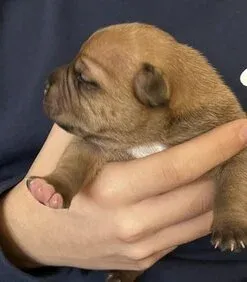
Ask for the laboratory certificates of both parents, as documents, with the dogs' names, microchip numbers and the laboratory's name legible: an accredited laboratory and a microchip that matches the dog are what make a report valid. A breeder who does things properly sends them without hesitation and often before you ask.
Be wary of any of the following: the phrase "the parents are healthy, they have never had problems", which addresses a different question entirely; certificates you are told you will receive later; a refusal to show the certificates before the puppy goes home; results shown only as a screenshot or a message; and the claim that testing is unnecessary "because our lines have never had it". No line is exempt from a recessive mutation until it is tested.
At Del Piccolo Diavolo the breeding dogs are tested, or clear by parentage with their parents' reports. The reports, with the microchip number, are published on the dogs' pages.
Beyond the two DNA tests
Besides L2-HGA and HC, a kennel that does things properly carries out other health checks on its breeding dogs.
Eye examinations (ECVO)
The ECVO eye examination (European College of Veterinary Ophthalmologists) is a clinical check carried out by a certified veterinary ophthalmologist. Unlike the HC genetic test, which detects the predisposition, the ECVO examination checks the current state of the dog's eyes.
The ECVO examination can detect cataracts already present, distichiasis, corneal dystrophy, progressive retinal atrophy (PRA) and other eye abnormalities.
Hip and elbow dysplasia
Although the Staffy is not among the breeds most affected by dysplasia, some breeders have official X-rays taken. In Italy the official reading is carried out by the FSA (Fondazione Salute Animale) or by Ce.Le.Ma.Sche.
Heart tests
Some breeders have echocardiograms carried out to rule out congenital heart conditions such as aortic or pulmonary stenosis, rare but present in the breed.
Breathing
Increasingly, breathing quality is being assessed as well. The Staffordshire Bull Terrier is not a brachycephalic breed, but the tendency towards ever shorter muzzles in some show lines has consequences, and a dog that struggles in warm weather or after moderate exercise has a welfare problem regardless of how it looks standing still. More on this in the guide to breathing in the Staffy.
📋 Health checklist for a breeder who does things properly
✅ L2-HGA DNA test, both parents CLEAR
✅ HC DNA test, both parents CLEAR
✅ ECVO eye examination (annual, recommended)
⭐ Dysplasia X-rays (optional but welcome)
⭐ Echocardiogram (optional but welcome)
✅ ENCI pedigree with a verifiable lineage
✅ Registered microchip
✅ Complete vaccinations and health record
The cost of prevention against the cost of the disease
Testing costs around 400 euros per dog, once. The lifetime cost of an L2-HGA affected dog runs into thousands, and the cost of cataract surgery for one eye is comparable to the price of the puppy. But the arithmetic is not really the point. The point is that a family who chose a healthy breed and paid for a pedigree puppy should never be put in that position, when a swab and 3 weeks of waiting would have prevented it entirely.
| Item | Who pays | When | Order of magnitude |
|---|---|---|---|
| L2-HGA + HC laboratory panel | Breeder | Once per dog | around €120 per dog |
| Sampling, shipping and the SOD1 test | Breeder | Once per dog | the rest of the outlay |
| Total per dog | Breeder | Once per dog | around €400 |
| Anti-epileptic drugs for a dog with L2-HGA | Family | For the dog's whole life | €200–400 a month |
| Neurological appointments and daily management | Family | Recurring, often until early euthanasia | variable |
| Surgery for hereditary cataract | Family | Once or twice | €2,000–4,000 per eye |
These are not two comparable expenses. Four hundred euros per dog, spent once, sits opposite a monthly cost that lasts as long as the dog does.